
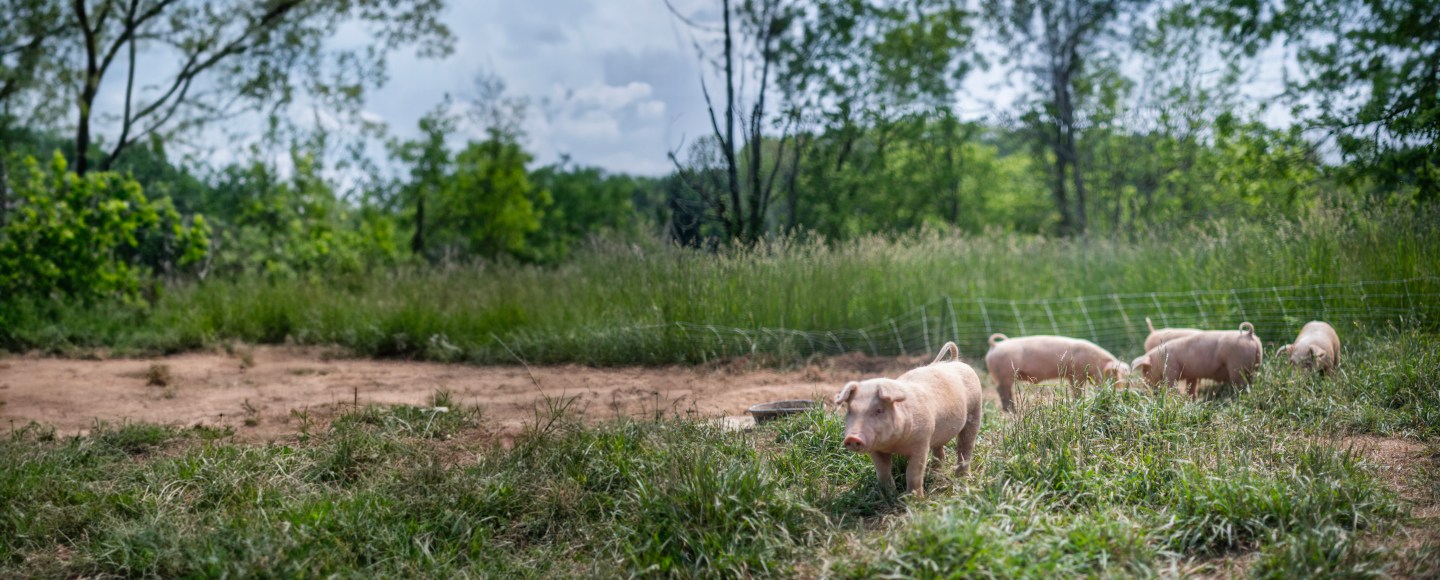

Soil is just dirt until we sow in it.
While there is something undeniably miraculous about untouched, untamed landscapes, the practice of agriculture has been a part of our human interaction with the planet for an estimated 10,000 years. Farming made community possible, enabling our ancestors to depart from nomadic origins in which we were exclusively hunter-gatherers. For thousands of years since, human history has been dictated by our success or failure at farming. Even the fall of Rome was related to poor harvests, and it’s as relevant today as it was then – however distanced we may be from that notion.

Hidden behind a small hill on Meetinghouse Road in Solebury is one of Bucks County’s most beautiful and environmentally conscious small farms. Photo by Kristina Gibb Photography.
Most Americans go through the day without thinking about the origin of their food or its quality beyond ripe or rotten. Few consider the impact of cow poop on carbon levels, how chicken litter affects soil, or the role of plants in carbon exchange.
Luckily for us, there are people who think about this all day long. They study it, talk about it, and farm based on it. Retracing the steps of a millennia long journey, they are embracing and reactivating wisdom that was forgotten after less than a century of industrial agriculture. Driven by a passion for food, health, community, and stewardship, the team at Spring Creek Farm in Solebury (PA) are among these restorers. They are putting the culture back in agriculture.


“Not the hardest working photo,” laughs Brent Alderfer, owner of Spring Creek Farm (standing, left image), with Events Coordinator Valerie Harris (seated). Though all work hard, Brent gives the credit to his team, led by Lead Farmer Hannah Hill and Livestock Manager Matt Dingle (L to R, right image). Photos by Kristina Gibb Photography.
Driving past the rolling hills that abut Aquetong and Meetinghouse Roads, the view of the farm is limited. As a hyper-local, the farm just three miles from my home and along the route to my aunt and uncle’s house, I noticed cattle in the pasture along the road one day. Not long after, chickens, and finally rows of vegetation. I am not a farmer, but I know enough to know that this was something special. I was curious and excited, but it would be a few years before I would roll down the long driveway and over the hill that hides this extraordinary and stunningly beautiful operation.
The day I arrived at Spring Creek Farm I had an almost “fan girl” exuberance. The sweeping views, the animals living in comfortable numbers on natural expanses, the colorful bee boxes stacked neatly near the farm’s center, the lovingly restored buildings, and the brilliant green rows of growth being tended by dedicated, gloved hands – every view is as picturesque as it is purposeful.
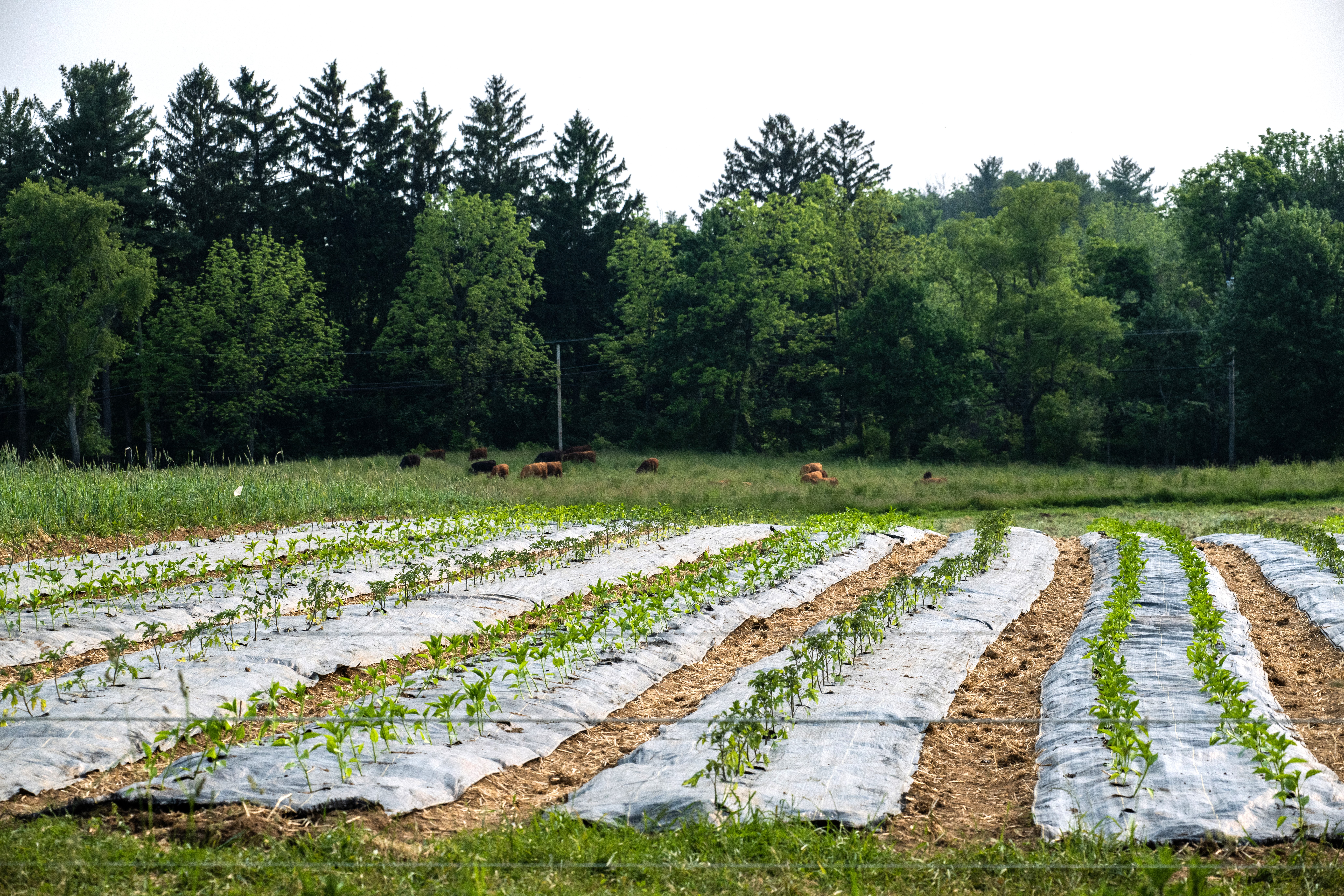
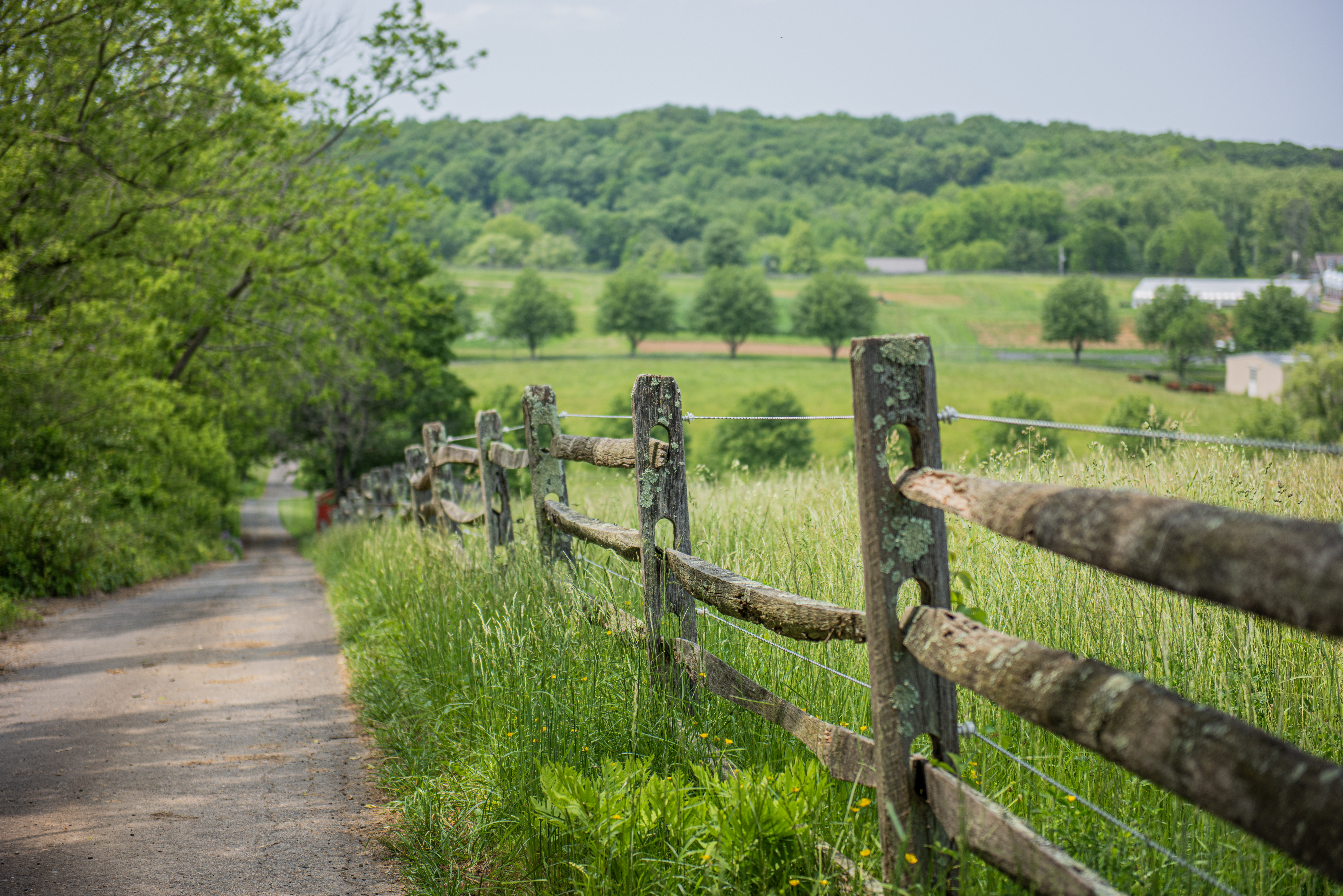
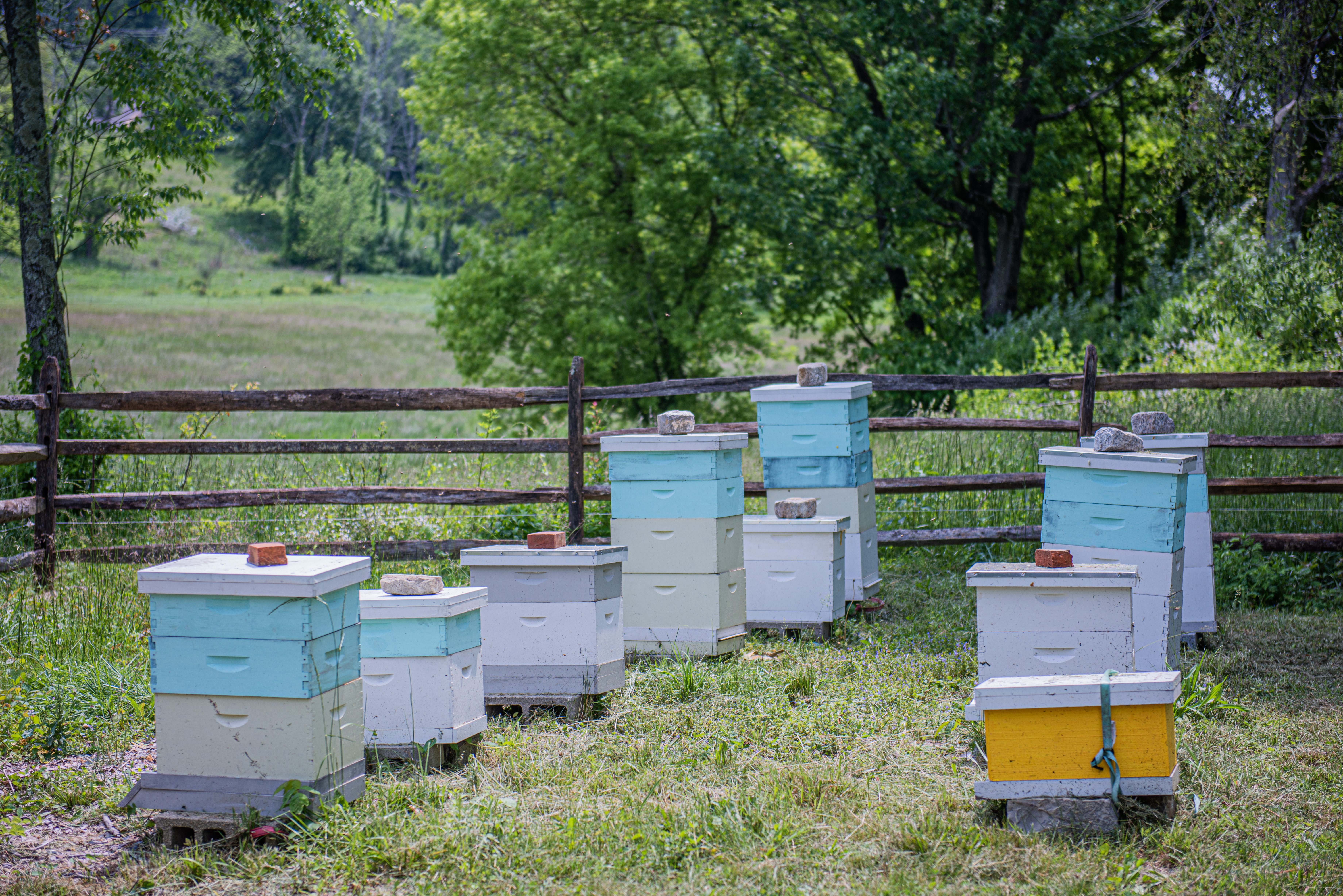


Gorgeous views in all directions on Spring Creek Farm. A timeless and beautiful testament to the ancient art of agriculture. Photos by Kristina Gibb Photography.
Approaching the barn, my contact, Valerie Harris, was the first to emerge. She was first introduced to the farm several years ago when she helped throw a party there for Laura Motley, a mutual friend of property owners, Brent and Dierdre Alderfer. Laura happens to be the apiary, raising bees at Spring Creek and selling their incredible honey. Owning an interior design business, Valerie wasn’t looking for work, but farm owner, Brent Alderfer, saw something special in what Valerie put together and pulled her in to develop a plan and calendar for sharing the farm with the community. Valerie couldn’t say no.
“I’m in it for the food, really,” she jokes, then sweeps her hand toward her surroundings, “and, I mean, look at this place.”
I get it. Who wouldn’t want to spend time here?
Thankfully, Valerie is making all kinds of opportunities for people to do that. Everything from yoga to picnics, cooking classes to family fishing populates the calendar. Though only about a dozen memberships are still available this year, offering flexible shares, special events, and a private shopping day, the public is invited to most goings-on. Additionally, the farm market is open to the public Fridays (noon to 6 pm) and Saturdays (9 am to 2 pm). You’ll find more than delectable fresh veggies there. The farm also sells its own beef, pork, and chicken products, as well as original recipe jarred items and other local goodies. Come for the kale, stay for the music! Not that you’ll want to leave, anyway. The farm is captivating.


Picturesque touches. Membership has its privileges, but the farm market and most events are open to the public. Photos by Kristina Gibb Photography.
Standing on the 120 acres of lush land anchored by an early 1800’s farmhouse, with animals grazing under trees hundreds of years old, one gets to experience being fully present in a place reflected in a Redfield or Bye. This is quintessential Bucks County, and it is what Brent came here for.
A Pennsylvanian hailing from Harleysville, Brent attended Northeastern for Electrical Engineering, but he wanted to make an impact on society. So, he headed to Georgetown Law. Once practicing, he realized the power for change didn’t come from the courthouse. It came from higher up, so he focused on policy making, an endeavor that would take him to Colorado where he worked on the Air Quality Control Commission and eventually the Public Utility Commission. Bringing his engineering knowledge, a head for business, and his determination, Brent set out to prove that renewable energy wasn’t just plausible, it was profitable. He knew that appealing to investors would be the best way to further this necessary environmental change. He built and sold two renewable energy companies, and has now started on the next big thing, asking himself his driving questions: “Where can I make a difference in the next clean energy transition? How can I accelerate capital to build it?”
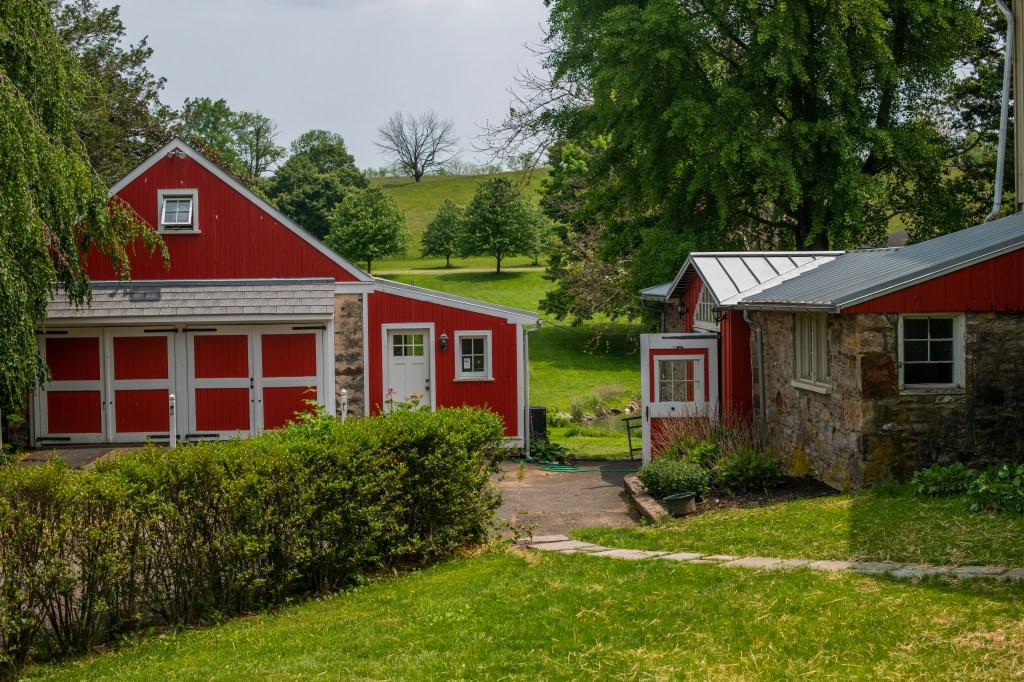
This little red carriage house is where members and guests of the farm will find the farm market. It sits between the Alderfer’s private residence and the barn. Photo by Kristina Gibb Photography.
With a love for all things green, a keen understanding of how to “sell” environmentalism, and a sincere desire to make the world a better place, Brent returned to Pennsylvania and settled in Radnor. He bought a small farm in Sergeantsville (NJ) and spent the summers there. Like any good businessman, he found the right people to do the jobs he couldn’t, got the land working, and started a CSA; but he kept his eye on the market for a farm he could live on all year. It took about 10 years for something to come up. In the year and a half that followed, he purchased three separate but adjoining plots, then embarked on a historically accurate, net zero energy refurbishment of the house and buildings, creating what is now his family’s home and farm at Spring Creek.
“The goal was always this,” he says, “to get clean, organic, local, great tasting food, and to share it with the community. I think we’re getting there, slowly getting the buzz, and people are enjoying it. Most people like what we’re up to, and that’s rewarding.”
What they’re up to is regenerative farming, a conservation driven approach to agriculture. The point is to farm in harmony with nature, to use all of the resources and byproducts of the farm to rejuvenate and restore balance to the land and the larger environment.
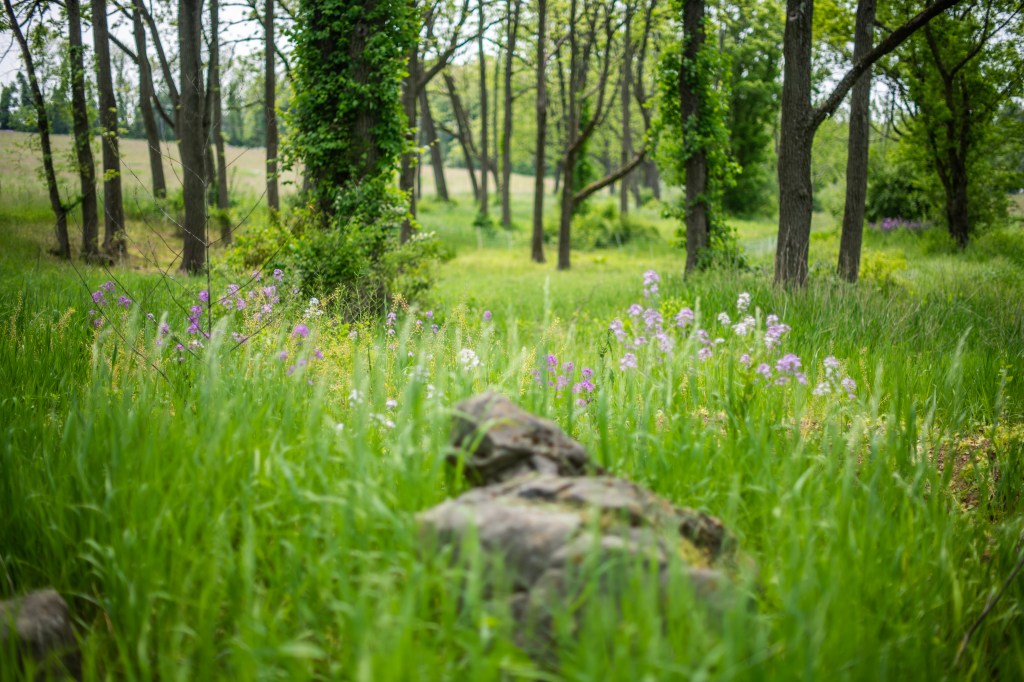
With 120 acres, some spaces are left to flourish naturally. Care for the environment is the top priority at Spring Creek, and balance is everything. Photo by Kristina Gibb Photography.
“Regenerative farming globally is an amazing climate story,” Brent explains. “Unlike most industries that are emitting carbon dioxide, which the agricultural industry does with fertilizers, fuel, transportation, ammonia,… regenerative farming removes carbon dioxide from the air and puts it to work building soil organic matter and fertility.” It does this through the rotation of animals and crops, strategic and low-impact soil disruption, periods of rest, and the application of science to work with nature, rather than chemicals. Practices that heal the planet.
“You can actually be a solution to climate change, instead of being part of the problem,” he says. “The real point is agriculture, globally, has the scale to do that, but to change over seems impossible. In the bigger picture, you want to prove that regenerative, local, environmentally sound, great tasting food can work financially, because that’s what lets it proliferate.”
As he did with solar and wind energies, Brent aims to demonstrate that this is a viable business model for farms all over the world because he knows how imperative it is for the health of our planet and our food systems. His knowledge of the climate science behind this approach is indisputably clear and downright impressive, but he gives all of the credit to the boots on the ground.
Those boots belong to Hannah Hill, Matt Dingle, and their team – which includes quite a few sets of hands, including Emmett Pegan, the field crew leader, and Roberto Escamilla, the property and facilities manager. Roberto has worked this land for several owners over the past 30 years and raised his three children there.
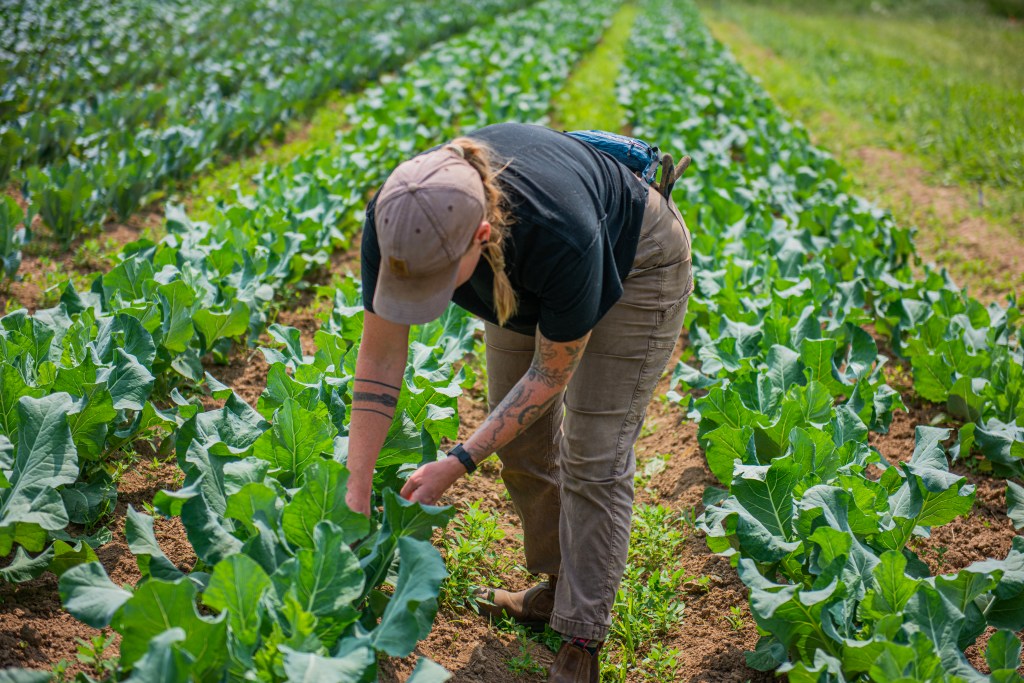
Lead Farmer Hannah Hill feels deeply connected to her work, drawing on childhood experiences to fuel her love of farming. Photo by Kristina Gibb Photography.
Though Roberto holds the place of having been on the land longest, even longer than the Alderfers, Hannah Hill is the lead farmer and field manager. Hannah is in her sixth year as a full-time farmer. She grew up having an “idyllic, sweet, dreamy little experience” in her mother’s garden where she spent considerable time in childhood. She left high school in pursuit of a more trade oriented education. By her early twenties, Hannah was living in South Philadelphia, where her food journey began.
She started working in a health food store, studying nutrition and holistic medicine, and she realized the relationship between health and food quality. Fascinated by what she was learning, she delved in even deeper, volunteering at urban community gardens. Once Hannah began digging in – literally, digging in dirt, she unearthed a deep love for farming. She became a “yes” girl, accepting more opportunities and trying her hand at bigger projects, until she was fully immersed in her farming career.
“I’ve just learned a lot by osmosis,” Hannah says. She watched the choices being made, observed the outcomes, paid attention to the issues, looked to make things more efficient, and broadened her knowledge. Without an official mentor, she used every human resource as well, capturing information from others – including her fiancé, who is also a farmer.
“It’s so helpful to be able to shoot the breeze and troubleshoot issues together,” Hannah says.


Plants are started in the greenhouse before being moved to the fields, which are made fertile by rotating the farm‘s animals through them. Photos by Kristina Gibb Photography.
Four seasons ago, Hannah came to Spring Creek, where she has continued to grow. Brent raves about her knowledge base, and in speaking to her, I can see why. We talked about permaculture versus regenerative practices, vertical tilling, the idea of treating the land with a “surgical” approach, carbon leaching, and the injuries and failures of industrial farming and its food. It is obvious Hannah genuinely cares about the impact she is having on the land, as well as the community she serves and the people she works with.
Leading the farm isn’t easy. Hannah explains that planning and preparation are critical. She prioritizes efficiency and the conservation of her staff’s energy. She strives to balance efforts in her managerial choices and emphasizes the importance of “creating space for people to bring their perspective, their skillset, and their creativity into the farm.”


Crew Leader Emmett Pegan gets plants in the ground, transferring countless items from the greenhouse to the soil each day. Photos by Kristina Gibb Photography.
“There’s intense pressure,” she explains. “You’re battling timelines, weather, weeds. You’re managing the flow of the farm, predation, labor.”
On the toughest days, she reflects on her early childhood in her mother’s garden, “just exploring that relationship (between people and agriculture). I have a lot of fond memories of that experience. I think that feeling really transfers to today and imbibes what I do with a little bit of magic, even when it’s very stressful.”
The magic in what Hannah does can be tasted in what she grows, and she finds that to be the most rewarding aspect of her work. “Seeing these incredible crops come out of the ground, then you eat them and talk about them with your customers. They go, ‘Oh, my god, that was the best tomato I’ve ever had.’ That to me is the greatest compliment.”
“It was always rewarding, working on sustainable ventures,” says Brent, “but I have never seen customers absolutely effusive like they are here about the taste and beauty of the produce that Hannah and her farm team grow.”
It is the result of Hannah’s tireless dedication, a dedication matched by her right-hand man, Matt Dingle, the livestock manager at Spring Creek.

Livestock Manager Matt Dingle introduces us to a darling spotted hog whom he is caring for as she enters the final few weeks of pregnancy. Photo by Kristina Gibb Photography.
Matt, like Hannah and Brent, wasn’t raised on a farm or formally educated as a farmer. He, too, was led to the work he does by following his heart. Originally from upstate New York, Matt was working in fundraising at a non-profit in Connecticut. The facility cared for individuals with disabilities and had a farm on the grounds.
“I gotta get my hands in the dirt,” he recalls thinking. Having married into a family that was a solid 30 years ahead of the organic food curve, Matt had a solid understanding of the necessity for clean, healthy farming. Thus, his family (which includes his wife and their five children) was already eating organically, but something didn’t seem right.
“All the organic food we were getting was shipping in from Arizona, California… I work so hard to make money to buy food that comes from so far away. I just thought I would bridge the gap and start making some myself. So, we got the chickens, and chickens are the gateway drug to farming.”

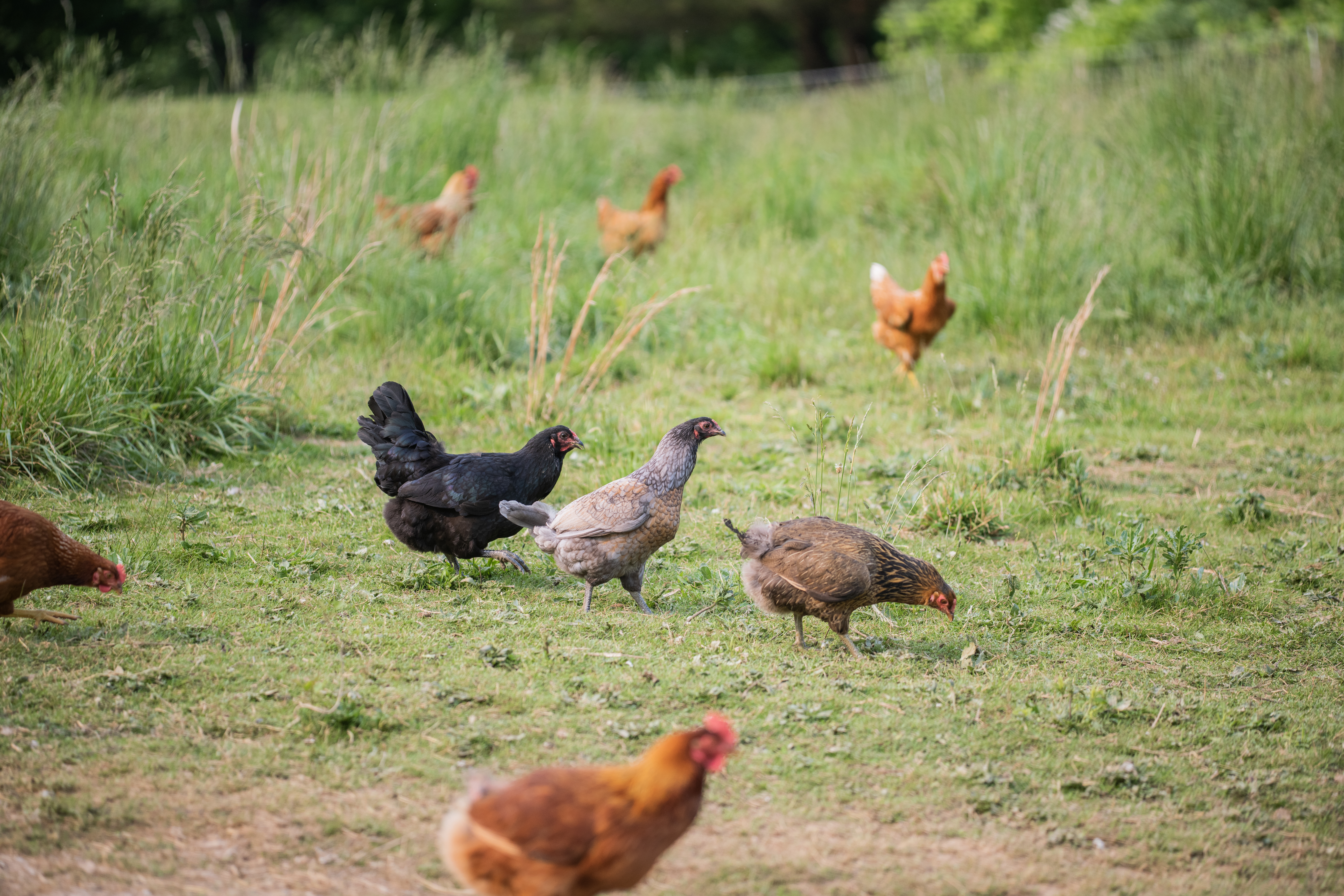


Chickens, “the gateway drug to farming.” Spring Creek Farm raises both roasting hens and laying hens. The flocks are guarded by teams of flock dogs. Phtos by Kristina Gibb Photography.
Soon, there were two jersey cows in his yard that his kids helped him milk. Not long after, Matt started wandering from his office to the farm end of the facility, and he was eventually offered the position of livestock manager. At the time, the facility was raising more than 100 heads of cattle per year and maintaining about 1,500 laying hens. The operation was massive compared to Spring Creek, where Matt sends steer one or two at a time to be processed for beef. Here, he maintains about 40 heads of cattle, in addition to small populations of hogs, roasting hens, laying hens, and some sheep. Turkeys come each year and are dispatched in time for Thanksgiving.
Like his cohorts, Matt’s knowledge is vast, and he values the land, but the way in which he approaches farming is almost mathematical. He looks to calculate the impact of the animals upon that land in very much the same way one would calculate costs in any other business. How much land do these animals need; how much feed will they eat in the winter; how much impact does providing their food have; how much product will come from these animals; and how much of this waste can be put back to work? If the impact of the animal can’t be negated by the rest of the farming practice, then you’re upside down.
“You want a minimal amount of damage,” Matt explains as we walked through a field where steers are grazing. “If you use [your livestock] properly, which you should, then you’re going to have more lush grass. It’s going to be more nutrient dense, and your stocking density – you’re going to have more cows in a smaller area. That’s the goal.”
The goal for Matt is bigger than cattle density, though. As it is for Hannah and Brent, Matt is ultimately focused on stewardship of the land. There are going to be consequences in agriculture. The trick is to prevent those consequences from being negative, because when they are – as Matt puts it – “you borrow against your own future.”
Those are poignant words. We have been borrowing against our future for a long time. We see it every day. Our seasons are changing; our forests are burning; our seas are rising; our wildlife is vanishing to extinction; and our food is making us sick with allergies and ailments. Yet somehow, we continue on the path of consumption without conscientiousness. We believe the rhetoric delivered to us by the peddlers of the poisons themselves. They tell us the only way we can feed people is through concentrated feeding operations, where animals are too crowded and sick to stand, and that genetically modified seeds on chemically treated land are the only way to produce adequate crop yields. They tell us that we can’t feed our communities the way Spring Creek Farm is feeding theirs, but if we reclaimed every industrial acre and returned it to people like Brent, Hannah, and Matt – we absolutely could.





Feeding their community of more than 300 members in addition to guests who shop on public market days, Spring Creek proves that profit is possible at the intersection of agriculture and environmentalism. Photos by Kristina Gibb Photography.
With love, patience, and the wisdom of the ancients, Spring Creek Farm is putting up the most nourishing thing of all… They’re giving us broccoli, beef, and eggs, but most importantly, they’re giving us a new perspective on ancient practices with the future in mind.
They’re giving us food for thought.
Take a bite. It’s delicious, and it will change your world.
 The River Bridges
Very nice, Jill. You should write for Bucks County Magazine. I had no idea that Spring Creek Farm existed and that in part it’s open to the public.
LikeLike
Thank you! A bit longer than usual, but there were so many wonderful faucets to explore. I guess that is the beauty and danger of having your own platform. I hope readers will enjoy the extra few minutes it will take to read, as the story they tell is well worth it.
LikeLike